

If you’re wondering “is Manhattan expensive to live” compared with Austin, the answer for most households is yes. Housing, taxes, and everyday costs tend to run much higher in Manhattan, even though Austin has become one of the pricier cities in Texas.
Thinking about trading the concrete canyons of New York City for the live music and breakfast tacos of Texas? The Manhattan vs Austin debate is heating up for many people right now, and for good reason. It’s a culture shift, a financial reset, and a lifestyle overhaul all rolled into one big decision.
You might love the energy of Manhattan. You live for the 24/7 pace, the walkability, and having the world at your doorstep. But maybe the average rent is getting to you, or you’re craving more green space and a slightly slower daily rhythm without sacrificing career opportunity.
Deciding between Manhattan vs. Austin isn’t just about picking a new city; it’s about choosing how you want to spend your time and money. Below, you’ll find a clear breakdown of housing, cost of living, jobs, and lifestyle so you can compare both cities and see where you’ll feel most at home.
- Housing Market: Manhattan vs Austin
- Cost of Living: Is Austin More Expensive Than Manhattan?
- Career and Job Market
- Lifestyle and Culture
- Transportation and Walkability
- Urban Core Showdown
- Taxes and Financial Outlook
- Austin Neighborhoods
- Frequently Asked Questions About Manhattan vs Austin
- What salary do I need to live comfortably in Manhattan vs Austin?
- Is it cheaper to keep renting in Manhattan or buy a home in Austin?
- Can I live car-free in Austin like I can in Manhattan?
- How do property taxes compare between Manhattan and Austin?
- What are smart first steps if I’m planning to move from Manhattan to Austin?
- The Verdict: Manhattan vs Austin Living
Housing Market: Manhattan vs Austin

The housing markets in Manhattan and Austin are fundamentally different. In Manhattan, space comes at a premium, with typical home values now hovering in the low seven figures. Recent data from Zillow shows the average home value in New York County (Manhattan) is roughly $1.18 million, while Austin’s average home value is closer to $490,000 as of late 2025. These figures change over time, but the gap between the two markets has remained significant.
That’s more than double the price difference for buyers. Austin’s market offers a mix of newer construction, single-family homes, townhomes, and condos, plus more flexibility in closing timelines.
In New York, co-op board approvals and drawn-out contracts can stretch the process to 90 days or more. In Texas, it’s often closer to 30 to 45 days with straightforward documentation, especially when you work with an experienced local agent who understands the contracts and norms.
| Metric | Manhattan, NY | Austin, TX |
|---|---|---|
| Average Home Value | $806,834 | $497,815 |
| Closing Time | 60–90+ days | 30–45 days |
| Average Monthly Rent (1BR) | $4,024 | $1,392 |
| Housing Type | Condos, co-ops, luxury high-rises | Single-family homes, townhomes, new builds |
| Market Characteristics | Limited space, older inventory, high entry costs | Faster transactions, newer inventory, flexible financing |
In Manhattan, buying property often means entering a highly competitive market dominated by co-ops and condos with extensive board approvals. Buyers typically need large down payments, often 20% to 30%, and face stricter lending criteria plus recurring costs like common charges and higher taxes.
Renters also experience some of the highest monthly costs in the nation, where a modest one-bedroom can easily exceed $4,500 per month in many neighborhoods, with luxury apartments crossing the $6,000+ range.
In contrast, Austin provides more breathing room, both financially and literally. A one-bedroom in a central Austin neighborhood typically costs far less than a comparable unit in Manhattan, and larger apartments or townhomes are widely available for a fraction of the price. For anyone weighing the pros and cons of rent vs buying a home in Austin, the city offers flexible options that fit a range of budgets and lifestyles.
Homebuyers in Austin can often expect lower down payments, more lender options, and a smoother purchasing process. Texas’ straightforward contract system and lack of state income tax can make ownership even more appealing, especially for high earners relocating from Manhattan.
For those moving to Austin from NYC, the transition often means trading high-rise views for more space, a yard or outdoor access, and a wider selection of newer homes. Manhattan’s market, while mature and historically strong, frequently comes with higher carrying costs due to taxes, common charges, and maintenance fees.
Cost of Living: Is Austin More Expensive Than Manhattan?

When it comes to everyday expenses, the cost-of-living difference between Manhattan and Austin is striking. Multiple cost-of-living indexes place Austin slightly to moderately above the U.S. average, while New York City ranks among the most expensive metros in the country. For most households, your budget stretches further in Austin even though it is no longer a “cheap” city.
If you’re asking, “is Austin more expensive than Manhattan?” the short answer is no for most categories. Manhattan’s higher housing costs, taxes, and healthcare expenses usually outweigh Austin’s higher property taxes and rising home prices, especially over the long term.
| Category | Austin, TX | Manhattan, NY | Difference |
|---|---|---|---|
| Energy Bill | $204.70 / month | $239.75 / month | Manhattan is 17% higher |
| Phone Bill | $192.95 / month | $225.99 / month | Manhattan is 17% higher |
| Gas (per gallon) | $3.07 | $3.81 | Manhattan is 24% higher |
| Loaf of Bread | $3.80 | $4.65 | +22% in Manhattan |
| Gallon of Milk | $4.53 | $5.54 | +22% in Manhattan |
| Carton of Eggs | $3.43 | $4.19 | +22% in Manhattan |
| Service | Austin, TX | Manhattan, NY | Difference |
|---|---|---|---|
| Doctor’s Visit | $140.49 | $210.00 | +49% in Manhattan |
| Dentist Visit | $114.67 | $171.42 | +49% in Manhattan |
| Optometrist Visit | $127.34 | $190.35 | +50% in Manhattan |
| Prescription Drug | $20.07 | $30.01 | +50% in Manhattan |
| Veterinary Visit | $64.25 | $88.96 | +38% in Manhattan |
The numbers tell a clear story: Austin delivers big-city energy without Manhattan-level price tags. While Manhattan dazzles with its iconic skyline and cultural scene, its costs make everyday living a challenge for many residents and even high earners.
- Utilities & Essentials: Austin typically stays closer to national averages, while Manhattan frequently exceeds them.
- Groceries & Dining: You can expect to pay noticeably more for the same meal or grocery basket in Manhattan than in Austin.
- Healthcare: Routine medical expenses and specialist visits are often significantly higher in Manhattan.
For those seeking affordability without sacrificing opportunity, Austin’s cost of living stands out as a more balanced option. It allows many residents to free up more of their budget for homeownership, recreation, travel, and savings.
In short, living in Austin tends to mean living smarter from a budget standpoint: your money generally goes further, your home often feels bigger, and your lifestyle can still be rich in culture, food, and outdoor experiences.
Career and Job Market
Manhattan continues to dominate finance, law, media, and fashion, with a dense network of global firms and highly competitive opportunities. It’s a city built for professionals chasing high-powered roles and willing to trade work-life balance for career acceleration and networking.
Austin, in contrast, is thriving as a tech and innovation destination. Nicknamed Silicon Hills, it’s home to major campuses from Dell, Apple, Tesla, Google, and Meta. The tech boom has expanded into startups, green energy, digital marketing, and creative industries, making it an attractive choice for professionals looking to relocate to Austin and join one of the fastest-growing innovation hubs in the country.
- Manhattan: Strong for legacy industries and global headquarters.
- Austin: Explosive tech scene with plenty of room for career growth.
- Growing support for startups, entrepreneurship, and remote workers in Austin.
- Austin promotes a healthier work-life balance with more flexible work environments and outdoor access.
Austin’s job and population growth have also driven migration from both coasts. With fewer barriers to entry and a supportive business climate, more people are launching businesses or finding fulfilling roles in emerging industries while enjoying a lower cost of living than Manhattan.
Lifestyle and Culture
Manhattan thrives on ambition. The energy is magnetic and relentless. Weekends may still involve client dinners, networking events, or packed restaurants. It’s the place to be for culture, luxury, and round-the-clock convenience.
Austin trades that constant intensity for a more laid-back but still lively rhythm. You’ll find locals hiking the Greenbelt, paddleboarding on Lady Bird Lake, sipping craft brews on patios, or listening to live music on almost any night of the week.
- Manhattan: Broadway, world-class museums, fine dining, and highly curated experiences.
- Austin: Festivals like SXSW and ACL, an active music and art scene, and laid-back patios.
- New York social life is often closely tied to work and industry events.
- Austin emphasizes authenticity, personal connection, and creative expression.
Austin is known for its friendly community feel and vibrant local culture. Newcomers often remark how quickly they feel at home, with welcoming neighbors, quirky traditions, and countless ways to plug into city life through interest groups, music, and outdoor activities.
Transportation and Walkability
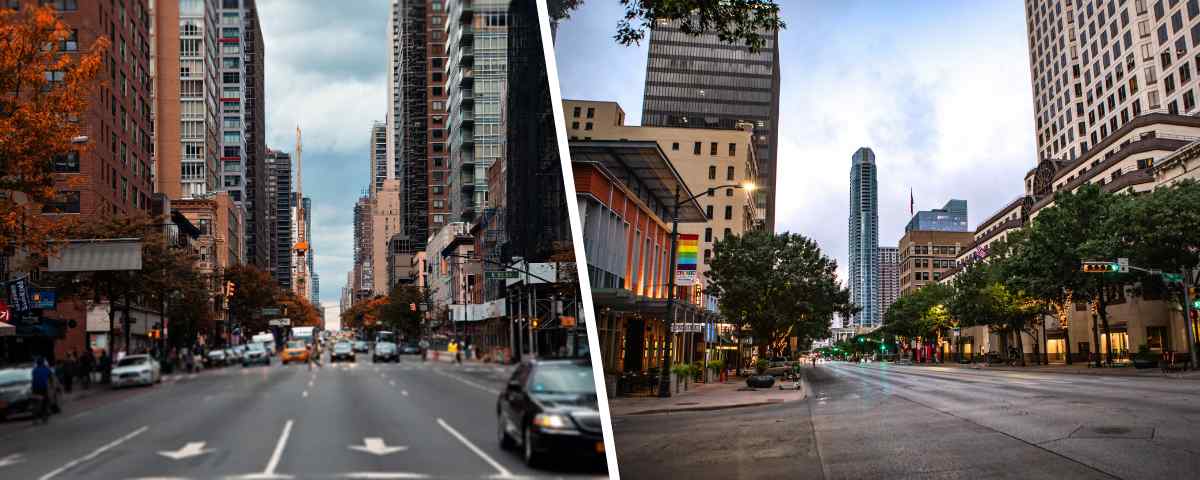
New York City is unmatched in its walkability and public transit network. Subways, buses, ferries, and bike lanes make it realistic to live without a car. Commuting time is often predictable, and costs like gas, insurance, and parking may not enter your monthly budget at all.
Austin, by comparison, is still primarily a city of drivers. While downtown, South Congress, and the Domain offer walkable pockets, most residents rely on cars for commuting, errands, and social life. The city is working to expand its public transit system, but it still lags behind NYC in coverage and frequency.
| Metric | Manhattan | Austin |
|---|---|---|
| Walk Score | 88 | 42 |
| Transit Score | 89 | 35 |
| Avg. Commute | 31 min (public) | 35+ min (car) |
- Manhattan allows true car-free living for many residents.
- Austin requires driving in most neighborhoods, but scenic routes, trails, and greenbelts offer balance.
- Transit expansion projects are underway in Austin, including Project Connect and CapMetro rail improvements.
Despite lower walkability, Austin offers a growing network of bike lanes, pedestrian-friendly parks, and outdoor spaces. For those interested in exploring walkable neighborhoods in Austin, the city continues to evolve with vibrant mixed-use districts that combine convenience, community, and access to green spaces.
Urban Core Showdown
Manhattan is the archetype of urban density. Every inch is maximized. From Midtown to SoHo, it’s a nonstop buzz of retail, offices, apartments, and foot traffic. For many, that’s the appeal—and also what makes it feel expensive and intense.
Austin’s downtown core is smaller and more manageable, with an artsy and relaxed vibe. The skyline is growing, but it still feels open compared to Manhattan. Central Austin neighborhoods like Zilker, South Lamar, and East Austin mix walkability with local charm and more access to nature.
- Downtown Austin features scenic lake access, walkable nightlife, and residential towers.
- The Domain in North Austin acts as a tech and lifestyle hub with high-end amenities and major employers.
- East Austin blends long-time local character with new growth and cultural hotspots.
- Neighborhoods like Westlake offer luxury homes with views, while South Congress keeps things creative and eclectic.
Austin’s urban design supports a live-work-play lifestyle across multiple districts, reducing the pressure on any single city center and giving newcomers options aligned with their pace and budget.
Taxes and Financial Outlook
New York residents face some of the nation’s highest income tax rates, with combined state and city taxes for top earners reaching well into the double digits. Over time, that can significantly reduce take-home pay, especially when paired with high housing and everyday costs.
Texas, on the other hand, has no state income tax on wages. While homeowners should still consider the property tax rate in Austin and higher sales taxes, the overall tax structure can create meaningful savings for many households relocating from Manhattan.
| Tax Type | Manhattan (NYC) | Austin (TX) |
|---|---|---|
| State Income | Up to 10.9% | 0% |
| City Income | Up to 3.876% | 0% |
| Property Tax | 1.6% | 1.6% |
| Sales Tax | 8.875% | 8.25% |
- Manhattan’s tax burden can reduce after-tax income and savings potential, especially for high earners.
- Texas’ tax structure supports business owners, remote workers, and professionals focused on building long-term wealth.
- Austin’s tax-friendly environment is a key part of its appeal for people leaving higher-tax states.
When you compare after-tax income, potential home equity growth, and overall affordability, Austin often delivers more value on every dollar earned—especially when combined with lower housing costs than Manhattan.
Austin Neighborhoods
Manhattan’s neighborhoods are dense and well-defined—think Tribeca’s luxury, the East Village’s nightlife, or Harlem’s deep history. In Austin, neighborhoods are more spread out and distinct, offering a blend of city amenities and natural serenity.
- Downtown Austin offers skyline views, nightlife, and access to Lady Bird Lake.
- South Congress (SoCo) delivers a mix of artsy culture, shopping, and walkable fun.
- The Domain is a master-planned district with upscale retail, offices, and apartments.
- Westlake provides luxury homes, top-tier schools, and panoramic views.
- East Austin attracts creatives, young professionals, and developers with its arts scene and revitalization.
If you’re still exploring which Austin neighborhood feels most like “you,” guides like our best neighborhoods to live in Austin and city Communities page are helpful starting points.
Frequently Asked Questions About Manhattan vs Austin
What salary do I need to live comfortably in Manhattan vs Austin?
“Comfortable” will look different for every household, but most cost-of-living tools show that the income needed to live comfortably in Manhattan is significantly higher than in Austin. Many New Yorkers find that their existing salary can support a larger home and more savings in Austin, especially when they keep a remote or hybrid role.
Is it cheaper to keep renting in Manhattan or buy a home in Austin?
For some people, especially high earners, buying in Austin can cost less month-to-month than renting a similar-quality apartment in Manhattan. However, this depends on your down payment, interest rate, and time horizon. Our renting vs. buying in Austin guide walks through the numbers in more detail.
Can I live car-free in Austin like I can in Manhattan?
Most people cannot live fully car-free in Austin the way they can in Manhattan. Some downtown and central neighborhoods are walkable and bike-friendly, and rideshare or transit can fill gaps, but a car remains the norm. Many former New Yorkers choose a central Austin neighborhood to minimize driving time while still enjoying more space.
How do property taxes compare between Manhattan and Austin?
Property tax rates in Texas, including the Austin area, are generally higher than in New York City, but there is no state income tax. In Manhattan, owners may face lower property tax rates but higher income taxes and building-related costs. The overall impact on your budget depends on your income level, home price, and how long you plan to hold the property.
What are smart first steps if I’m planning to move from Manhattan to Austin?
Start by reviewing your budget with up-to-date cost-of-living data, then narrow down Austin neighborhoods that match your lifestyle and commute needs. From there, connect with a local real estate consultant, consider a scouting trip, and use resources like our relocation guide to plan timelines, school research, and logistics.
The Verdict: Manhattan vs Austin Living
The Manhattan vs Austin decision comes down to what lifestyle and financial strategy you want for your next chapter. Manhattan will always be a global center for finance, fashion, and media, but for many people, Austin provides the space, pace, and cost advantages that make daily life feel more sustainable.
From tacos and tech to trails and tax breaks, Austin is gaining ground with people who want strong careers without sacrificing quality of life. If you’re seriously considering a move, it helps to look at real numbers for your income, housing budget, and timeline—and talk through options with someone who knows the Austin market.
Planning a move to Austin from Manhattan or anywhere in New York? Get expert help from a local real estate consultant. Call 512.890.1597 or send us a message at contact us here to talk through neighborhoods, timelines, and budgets.
Resources: